
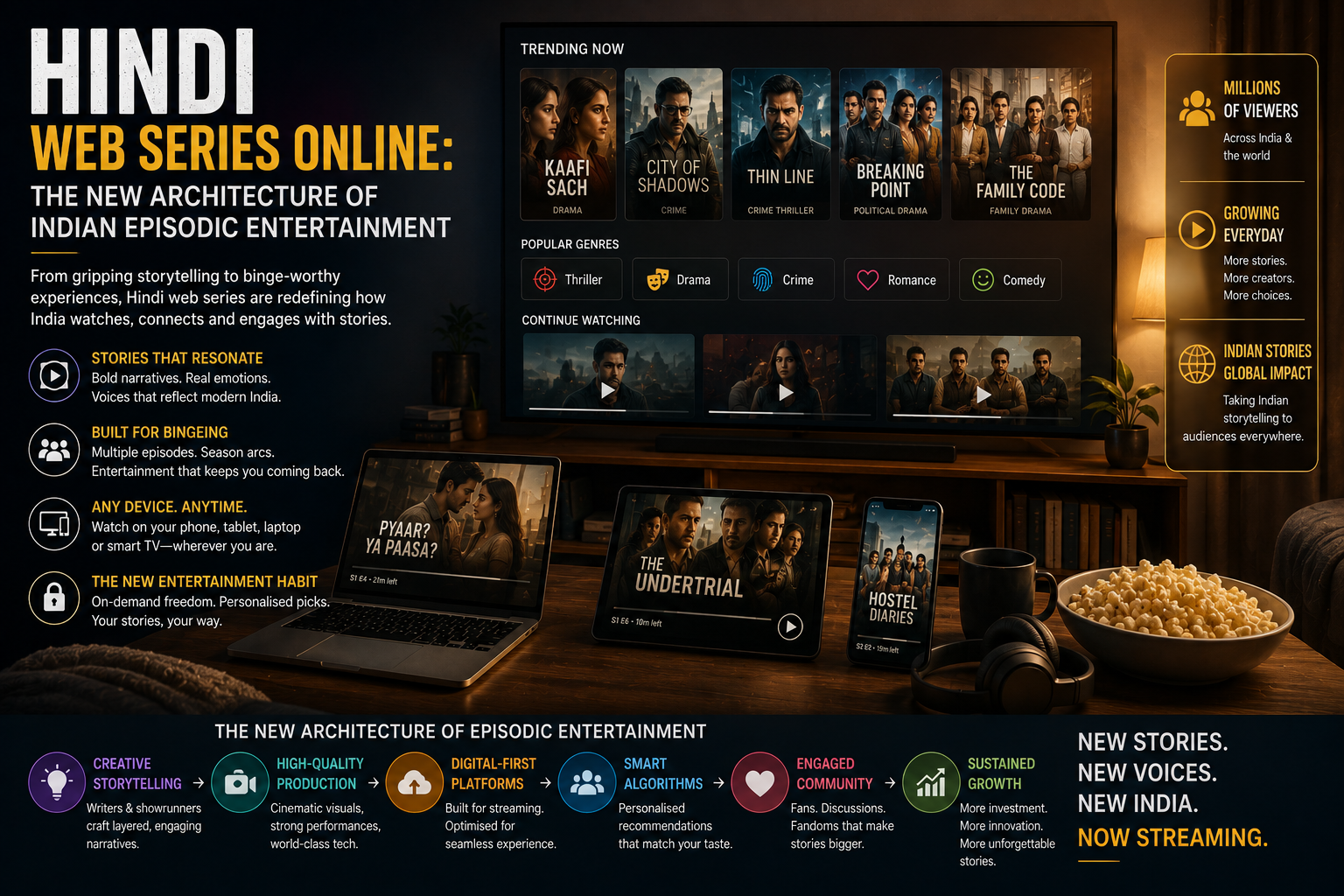
Hindi web series have become an important part of India’s digital entertainment culture, giving episodic programming a format that is more flexible than traditional television. Viewers can discover series through online catalogs, return to episodes according to their own schedules, and move between genres without being tied to a broadcaster’s timetable. For audiences searching for हिंदी वेब सीरीज ऑनलाइन , this shift creates a more direct way to explore Hindi-language episodic entertainment through a modern digital environment.
From Television Schedules to Personal Viewing Rhythms
The original appeal of web series was closely connected with freedom from conventional television programming. An episode could be paused, resumed, rewound, or watched at a different time instead of requiring the audience to be in front of a television at a predetermined hour. That basic principle remains one of the strongest reasons episodic content fits naturally into streaming.
The scale of India’s digital audience shows how deeply this viewing model has developed. Ormax’s 2025 research estimated India’s OTT audience at 601.2 million people, with active paid subscriptions reaching 148.2 million. The same research estimated the active connected-TV base at 129.2 million, demonstrating that streaming is no longer confined to smartphones and laptops.
For Hindi web series, this creates a broad viewing environment. An episode can be part of an evening routine on a television, a short break on a laptop, or a mobile viewing session elsewhere. The format adapts to the audience instead of requiring the audience to adapt to the schedule.
Why Episodic Entertainment Works Differently Online
A web series is naturally suited to repeated digital visits. Instead of making one decision about a single film, viewers can return to the same catalog over an extended period. This creates a different relationship with the platform, where discovery, continuation, and browsing become interconnected.
The growth of online entertainment has also expanded the range of Hindi episodic formats. Contemporary catalogs can include drama, comedy, crime, suspense, romance, social subjects, reality-based programming, and hybrid formats that would be difficult to classify within a traditional television schedule.
The diversity of current streaming programming reflects this evolution. Netflix India, for example, described its 2026 content strategy as emphasizing greater diversity, scale, and experimentation, illustrating how Hindi-language streaming is developing within a broader digital ecosystem.
For audiences, this means that “web series” is no longer a narrow format. It has become a broad category encompassing different genres, production styles, episode structures, and viewing habits.
Hindi Remains Central in a Multilingual Streaming Market
India’s streaming environment is multilingual by nature. Hindi occupies a major position, but digital catalogs also increasingly serve audiences in Bengali, Tamil, Telugu, Malayalam, Marathi, Kannada, and other languages.
A government-backed industry report highlights the growth of language-specific online curated-content services in India, noting that regional platforms can build strong positions by tailoring catalogs to linguistic and cultural preferences.
This is significant for Hindi web series because the language remains both a cultural identity and a practical discovery category. A viewer looking specifically for Hindi entertainment should not have to navigate an undifferentiated international catalog before finding relevant content.
Language-based organization makes discovery faster. It also allows Hindi episodic entertainment to exist alongside other Indian-language ecosystems without losing its own identity.
The Catalog Has Become Part of the Entertainment
Traditional television primarily presented programming. Streaming catalogs do something different: they invite audiences to explore.
A well-structured digital shelf can organize Hindi series by genre, recency, collections, or other useful characteristics. This helps viewers arrive at a decision without requiring them to know the exact title beforehand.
That matters because discovery is now a major part of online viewing. Ormax’s 2026 mid-year OTT report measures films, web series, and reality programming across India’s streaming platforms, showing how digital audiences are increasingly studied as a distinct entertainment market.
For the viewer, however, discovery should not feel analytical. The interface should simply make it easy to browse, notice something interesting, open the title, and begin watching.
Moviewala’s direct catalog approach supports this kind of browsing. Viewers can select a Hindi series straight from the shelf without being stopped by a mandatory registration wall, while an uncluttered interface without annoying pop-ups keeps attention on the available entertainment.
The Rise of Mobile-First Episodic Viewing
Streaming habits are becoming increasingly influenced by mobile devices. India’s OTT market reached approximately 1.45 billion monthly active users in 2026 according to data reported by IBEF, with affordable mobile data and growing smartphone adoption identified as important drivers.
This has consequences for the design of Hindi web series platforms. A catalog cannot assume that viewers are sitting in front of a large television. The same content may need to work equally well on a phone, tablet, laptop, or connected television.
The rise of shorter digital formats illustrates how viewing habits are adapting to mobile environments. Research reported by The Indian Express in 2026 describes micro-dramas and vertical series as an emerging form of mobile-first entertainment aimed at viewers who want shorter sessions rather than traditional long-form viewing.
This does not mean conventional web series are disappearing. Instead, the digital ecosystem is becoming more flexible, with different episode lengths and presentation formats serving different moments in the viewer’s day.
A Seamless Journey From Shelf to Screen
The convenience of online entertainment can quickly disappear when the platform introduces unnecessary obstacles. Repeated registration requests, intrusive advertisements, complicated navigation, and excessive redirects can make a large catalog feel surprisingly difficult to use.
A premium viewing environment should reduce that friction. On Moviewala, the Hindi catalog can be explored directly, allowing viewers to select a series from the shelf and move toward playback without a mandatory sign-up process.
This is particularly useful for episodic entertainment because viewers often browse before deciding where to begin. A clean interface makes it possible to investigate different series, return to the catalog, and continue exploring without repeatedly encountering barriers.
The absence of annoying pop-ups also matters. When the interface remains visually quiet, the catalog itself becomes the focus, allowing discovery to feel more natural.
Hindi Series Across Every Modern Screen
Connected television has become an increasingly important part of India’s streaming environment, but mobile viewing remains equally significant. This means Hindi web series need to operate across an unusually broad range of screen sizes and viewing contexts.
A Smart TV can provide a traditional home-cinema environment for a longer session. A laptop can support individual viewing during the day, while a smartphone can make an episode available almost anywhere.
Responsive design allows these different habits to coexist. The visual hierarchy of the catalog should remain clear on a large screen while menus and playback controls stay practical on mobile devices.
The viewer should not have to think about this adaptation. A good interface simply responds to the screen being used while maintaining the same basic path from discovery to playback.
The Technical Layer Behind Continuous Streaming
Streaming an episodic series involves a sophisticated technical infrastructure because audiences repeatedly return for additional episodes. Video files must be delivered efficiently, playback needs to remain stable, and different devices require different resolutions and data rates.
Compression technologies help reduce the amount of data needed for high-quality video, while adaptive streaming can respond to fluctuations in available bandwidth. Cloud infrastructure and distributed content delivery systems help platforms serve viewers across different geographic regions.
These technologies become particularly important for Hindi content because the audience is spread across India and international markets. A viewer’s connection may differ substantially from another viewer’s, even when both are accessing the same episode.
The technical objective is therefore straightforward: the infrastructure should handle these variations quietly so that the viewer can concentrate on the series rather than the delivery system.
Streaming Is Becoming More Accessible by Design
Premium streaming is increasingly about accessibility as well as convenience. In March 2026, India’s Ministry of Information and Broadcasting issued guidelines for OTT platforms addressing features intended to improve access for viewers with hearing and visual impairments.
This reflects a broader change in how digital entertainment is evaluated. A modern platform is expected not only to provide content but also to make navigation and playback easier for a wider range of viewers.
For Hindi web series, accessibility can intersect with language support, readable interfaces, subtitles, audio features, and responsive controls. These elements can make a digital catalog more comfortable without requiring the interface itself to become complicated.
The strongest design philosophy remains unobtrusive. Useful accessibility features should work quietly in the background while the viewer remains focused on the entertainment.
Hindi Web Series in a Global Entertainment Market
Hindi-language episodic entertainment is increasingly reaching audiences beyond India’s borders. Netflix’s first-half 2026 viewing report showed Indian films and series generating 688 million global views, illustrating the broader international appetite for content originating from India.
This international reach is particularly relevant to web series because streaming removes many of the geographical restrictions associated with traditional television. A Hindi-speaking viewer living outside India can access Indian entertainment without depending on a local broadcaster.
At the same time, international viewers can encounter Hindi series through subtitles, dubbing, recommendations, and global catalogs. This creates an opportunity for Hindi-language entertainment to participate in a genuinely international streaming environment.
The language remains central, but geography becomes less restrictive.
Where Hindi Episodic Entertainment Is Heading
The future of Hindi web series will likely involve greater diversity in episode formats, more sophisticated discovery systems, broader device compatibility, improved accessibility, and increasingly personalized catalogs. India’s digital media market continues to expand, with OTT revenues projected to grow strongly through FY28.
At the same time, the growth of mobile-first entertainment suggests that audiences will continue expecting flexibility. Some viewers will prefer traditional long-form seasons on a television, while others may favor shorter sessions on smartphones.
The strongest platforms will be able to support both behaviors without making the interface complicated. A large Hindi catalog should feel approachable whether someone arrives with a specific series in mind or simply wants to browse.
The ideal experience remains calm and direct. Open the Moviewala Hindi catalog, explore the available series, select a title from the shelf, choose an episode, and press play. With high-quality playback, direct one-click access, no registration wall, and no distracting pop-ups, the technology can stay in the background while Hindi web entertainment takes center stage.